
Everything Google Announced at I/O 2026: Gemini 3.5, Omni, Spark, and the Search That’s Changed Forever
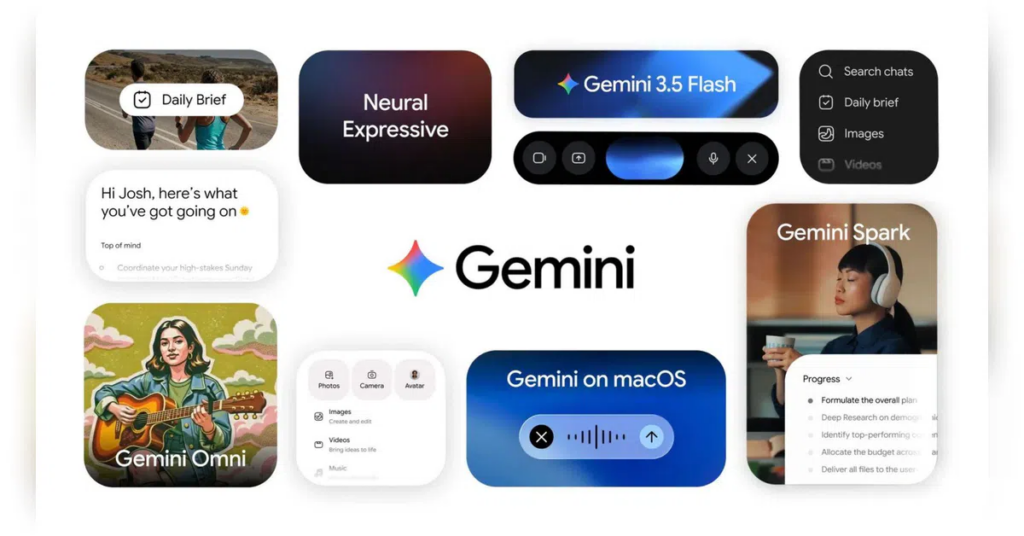
Google I/O 2026 wasn’t just another developer conference. It felt like Google announcing a complete reset of how the internet will work over the next decade.
For years, Google’s products revolved around search boxes, apps, and links. At I/O 2026, the company made it clear that the future is centered around AI agents — systems that don’t just answer questions, but actively perform tasks, create content, manage workflows, and operate continuously in the background.
The stars of the show were Gemini 3.5, Gemini Omni, Gemini Spark, and a radically redesigned Google Search experience. Together, they reveal Google’s biggest AI push yet — and possibly the company’s most important transformation since Android.
Gemini 3.5: Google’s New AI Foundation
At the center of almost every announcement was Gemini 3.5, Google’s next-generation AI model family.
The first rollout is Gemini 3.5 Flash, a faster and more efficient model that Google says is optimized for “frontier intelligence with action.” In simpler terms, it’s designed not only to understand requests, but to execute complex workflows and agentic tasks.
Google says Gemini 3.5 Flash is:
- Faster than previous Gemini models
- Better at coding and reasoning
- Built specifically for AI agents
- Integrated deeply into Search, Android, Workspace, and developer tools
The company also confirmed that Gemini 3.5 Pro is coming soon for heavier, more advanced workloads.
What matters most here is not just raw AI performance. Google is positioning Gemini 3.5 as the operating system for its entire ecosystem.
That means:
- Search runs on Gemini
- Android experiences run on Gemini
- Workspace tools run on Gemini
- Shopping systems run on Gemini
- Future wearables and XR devices run on Gemini
This is Google consolidating everything around one AI brain.
Gemini Omni: AI That Understands the World
If Gemini 3.5 is the brain, Gemini Omni is the imagination engine.
Google introduced Gemini Omni as a multimodal “world model” capable of creating and editing content from nearly any type of input — including text, video, audio, and images.
The first release, Gemini Omni Flash, focuses heavily on video generation and editing.
What makes Omni different from earlier AI video tools is contextual continuity. Instead of generating disconnected clips, Omni remembers previous instructions across conversations. Users can iteratively edit scenes, change lighting, alter perspectives, or modify actions while maintaining visual consistency.
In practical terms, that means you could:
- Generate a video from a text prompt
- Continue refining it through conversation
- Add or remove objects naturally
- Change camera angles mid-project
- Keep characters and environments consistent
Google appears to be aiming directly at the future of creative production — where AI becomes a collaborative filmmaking and design tool rather than a simple generator.
Omni is already rolling out across:
- The Gemini app
- Google Flow
- YouTube Shorts integrations
And it’s likely only the beginning.
Gemini Spark: Google’s 24/7 AI Agent
One of the most ambitious announcements at I/O 2026 was Gemini Spark.
Spark is Google’s answer to the growing race toward autonomous AI agents — AI systems that can operate continuously and proactively instead of waiting for prompts.
Google describes Spark as a “24/7 personal AI agent.”
Unlike traditional assistants, Spark can:
- Continue working in the background
- Handle long-running workflows
- Interact across apps and services
- Manage recurring tasks
- Coordinate information from Gmail, Docs, Calendar, and third-party platforms
Importantly, Spark doesn’t rely on your device remaining active. It runs on cloud infrastructure, meaning your AI assistant can continue operating even after you close your laptop.
Google demonstrated examples like:
- Preparing meeting summaries automatically
- Tracking important updates
- Drafting emails and documents
- Managing shopping workflows
- Coordinating tasks across enterprise apps
This is arguably the clearest signal yet that Google believes AI agents — not chatbots — are the next major computing platform.
Search Has Changed Forever
The biggest long-term announcement may not have been a model at all.
It was Search.
Google called this the largest transformation of Search in 25 years. That’s not marketing exaggeration — the company is fundamentally redesigning how users interact with the web.
Instead of presenting a page full of blue links, Google Search is becoming:
- Conversational
- Agentic
- Visual
- Interactive
- Action-oriented
The centerpiece is AI Mode, where Search behaves more like an intelligent workspace than a traditional search engine.
Google showed examples where Search could:
- Generate visual explanations instantly
- Help debug and write code
- Track events and reminders
- Build mini applications dynamically
- Execute shopping and booking tasks
- Coordinate workflows across Google services
The key shift is this:
Old Google Search helped you find information.
New Google Search tries to complete the task for you.
That changes the economics of the web entirely.
Publishers, creators, marketers, SEO professionals, and app developers are all going to feel the effects of this transition.
Universal Cart and Agentic Shopping
Google also announced Universal Cart, which may become one of the company’s most commercially important AI projects.
The idea is simple:
Instead of manually comparing products and checking out across different stores, AI agents can manage shopping workflows automatically.
Universal Cart aims to:
- Track products across merchants
- Coordinate purchases
- Handle recommendations
- Assist with checkout flows
- Integrate directly into Search and Gemini
This is Google attempting to turn shopping into an AI-assisted process rather than a browser-driven activity.
If successful, it could reshape ecommerce just as dramatically as AI Mode may reshape publishing.
Android XR and AI Wearables
Google also doubled down on AI-powered hardware.
The company showcased:
- Android XR smart glasses
- AI-integrated eyewear partnerships
- Project Aura updates
- Wear OS 7 improvements
Several announcements focused on making Gemini available beyond phones and laptops.
The message was obvious:
Google wants AI to become ambient and always available.
Rather than opening an app to use AI, users will increasingly interact with AI through:
- Voice
- Glasses
- Wearables
- Cameras
- Real-time environments
It’s a vision that looks much closer to science fiction than previous generations of consumer tech.
Google’s “Agentic Era”
Throughout the keynote, Google repeatedly used the phrase “agentic.”
That word may end up defining the entire post-chatbot phase of AI.
The company is moving beyond assistants that simply respond to prompts. Instead, Google wants AI systems that:
- Understand context
- Maintain memory
- Take actions
- Operate independently
- Coordinate across services
- Work continuously in the background
This strategy now touches nearly every Google product:
- Search
- Gmail
- Docs
- Android
- YouTube
- Shopping
- Cloud
- Developer tools
Google is no longer treating AI as a feature.
AI is becoming the interface itself.
Final Thoughts
Google I/O 2026 may eventually be remembered as the moment the internet officially entered the agent era.
Gemini 3.5 showed Google’s ambition to build the foundational intelligence layer for everything it makes. Gemini Omni revealed how far multimodal AI creation has evolved. Gemini Spark demonstrated Google’s belief in always-on autonomous assistants. And the overhaul of Search signaled the end of the traditional “10 blue links” web experience.
The biggest takeaway wasn’t a single product announcement.
It was the realization that Google is rebuilding its entire ecosystem around AI-first interaction.
And whether users, creators, publishers, and competitors are ready or not, the web is about to look very different.