
Astronomers Find a Solar System in the Milky Way That Breaks the Rules of Planet Formation
Introduction
For decades, scientists believed they had a solid understanding of how solar systems form. The standard model suggested that stars are born from collapsing clouds of gas and dust, and the remaining material flattens into a rotating disk. Over millions of years, particles within this disk collide and merge, gradually forming planets.
However, astronomers have recently identified a planetary system in the Milky Way that does not follow these traditional rules. Its unusual structure challenges long-standing theories and forces scientists to reconsider how planetary systems evolve.
The Traditional Model of Planet Formation
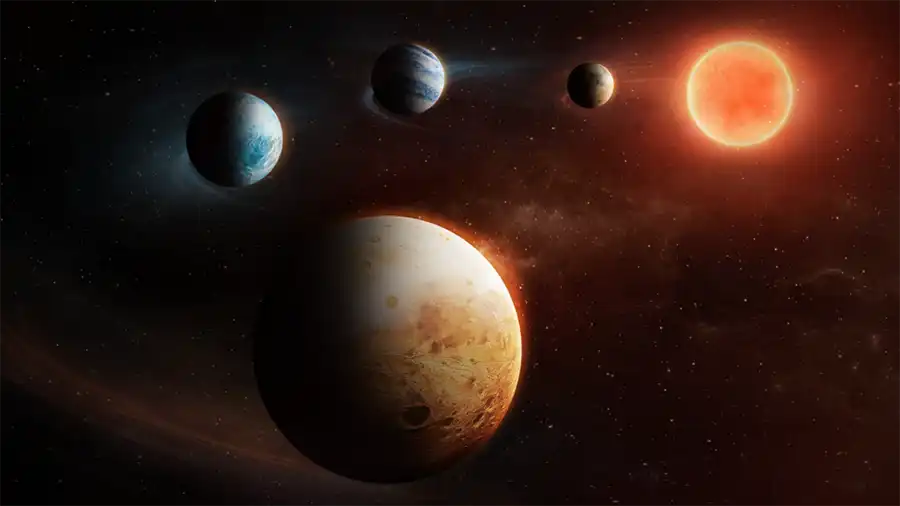
The most widely accepted explanation is the Nebular Hypothesis. According to this theory:
- Planets form in a flat, rotating disk of gas and dust surrounding a young star.
- Inner planets are typically small and rocky, like Earth and Mars.
- Outer planets are usually large gas giants, like Jupiter and Saturn.
- Most planetary orbits are circular and aligned within the same plane.
This model accurately describes our own Solar System and has served as a foundation for understanding planetary formation across the galaxy. But recent discoveries show that not all systems follow this pattern.
What Makes This Solar System Unusual
The newly observed system displays several unexpected characteristics:
Misaligned Orbits
Instead of orbiting in a single flat plane, some planets appear to have tilted or highly elliptical paths. This suggests a more chaotic formation history.
Giant Planets Close to Their Star
Gas giants have been detected extremely close to their host star. Traditionally, such massive planets were expected to form far from their star, where temperatures are lower. These close-orbiting giants, often called “hot Jupiters,” challenge earlier assumptions.
Irregular Planetary Arrangement
The system does not follow the common pattern of rocky planets near the star and gas giants farther away. Instead, the order appears mixed or disrupted.
Possible Gravitational Disturbances
Some researchers suspect that gravitational interactions—possibly from a nearby companion star or from interactions between planets—may have altered the system’s structure over time.
How Astronomers Detected It
Scientists used advanced detection methods, including:
- The transit method, which measures dips in a star’s brightness when a planet passes in front of it.
- The radial velocity method, which detects subtle movements in a star caused by the gravitational pull of orbiting planets.
- Observations from powerful space telescopes such as the James Webb Space Telescope.
These techniques allowed astronomers to analyze the system’s structure in detail and identify its unusual properties.
Why This Discovery Is Important
This discovery has significant implications:
Rethinking Planet Formation
If planetary systems can form in unexpected and chaotic ways, existing models may need refinement. Planet formation might be more dynamic than previously believed.
Expanding the Possibility of Habitable Worlds
A broader understanding of planetary diversity increases the likelihood that life-friendly environments could exist in unexpected places.
Challenging the “Typical” Solar System Assumption
Our Solar System may not be the universal template scientists once thought it was. Instead, it may represent just one outcome among many possibilities.
Possible Explanations
Astronomers are exploring several theories to explain the system’s unusual characteristics:
- Planetary migration, where giant planets form far from their star and later move inward.
- Gravitational scattering, where planets interact strongly and alter each other’s orbits.
- Binary star influence, where a second star disrupts the formation disk.
- Disk instability, where planets form rapidly from gravitational collapse rather than slow accumulation.
Each explanation suggests that planetary systems can undergo dramatic changes after their initial formation.
Conclusion
The discovery of a rule-breaking solar system in the Milky Way highlights how much there is still to learn about the universe. While traditional models have provided a strong framework, new observations reveal that planetary systems can be far more complex and varied than previously imagined.
As observational technology continues to improve, astronomers will likely uncover even more systems that challenge established theories. These discoveries not only reshape scientific understanding but also deepen our appreciation for the diversity and complexity of the cosmos.