
Meet Athena: NASA Supercomputer Can Do in a Day What Your PC Would Take 500 Years
As scientific research becomes more complex and data-driven, traditional computing systems are no longer sufficient to handle the scale of modern challenges. To meet these demands, NASA has introduced Athena, a next-generation supercomputer designed to process massive workloads at extraordinary speeds. Athena represents a major leap in high-performance computing, capable of completing calculations in a single day that would take an average personal computer centuries to finish.
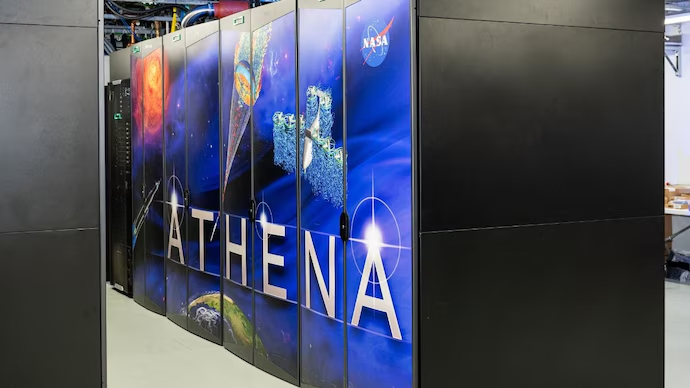
What Is Athena?
Athena is one of NASA’s most powerful supercomputers, developed to support advanced scientific research, space exploration, and complex simulations. It is built using thousands of high-performance processors working in parallel, allowing it to handle enormous volumes of data simultaneously. Unlike consumer PCs, which are designed for general tasks, Athena is purpose-built for extreme computational performance.
Why Athena Is So Powerful
The key strength of Athena lies in parallel processing. While a typical PC uses a limited number of CPU cores, Athena combines tens of thousands of cores, along with advanced accelerators, to perform calculations at unprecedented speeds. Tasks that require trillions of mathematical operations can be divided and processed simultaneously, dramatically reducing execution time.
Athena also benefits from ultra-fast memory systems and high-speed interconnects that allow data to move efficiently between processors. This architecture eliminates bottlenecks that would severely slow down standard computers.
What Takes 500 Years on a PC
Certain scientific simulations involve modeling highly complex systems, such as climate patterns, spacecraft aerodynamics, or astrophysical phenomena. These simulations may require running millions of variables across countless iterations. On a standard desktop or laptop, processing such workloads would take hundreds of years due to limited computing power and memory constraints.
Athena can complete these same workloads in about a day, making previously impractical research not only possible but routine.
Applications of Athena at NASA
Athena plays a critical role in multiple NASA missions and research areas. It is used for:
- Simulating spacecraft design and performance before physical prototypes are built
- Modeling Earth’s climate and atmospheric behavior
- Analyzing vast datasets from space telescopes and satellites
- Supporting mission planning and risk assessment for deep-space exploration
By accelerating these processes, Athena helps NASA reduce costs, improve accuracy, and make faster, more informed decisions.
Impact on Scientific Discovery
Supercomputers like Athena are transforming the pace of scientific discovery. Researchers can test more scenarios, refine models with greater precision, and explore possibilities that were once computationally impossible. This capability shortens development cycles and opens the door to breakthroughs in space science, physics, and Earth studies.
How Athena Compares to Consumer PCs
A consumer PC is optimized for everyday tasks such as browsing, office work, and light data processing. In contrast, Athena is designed to run continuously at maximum capacity, handling workloads that require extreme precision and speed. The difference is not incremental but exponential, which explains how Athena can outperform a personal computer by hundreds of years’ worth of processing time.
Conclusion
Athena is a powerful example of how far computing technology has advanced. By completing in one day what would take a personal computer 500 years, NASA’s supercomputer enables faster research, safer missions, and deeper understanding of both Earth and the universe. As scientific challenges grow more complex, systems like Athena will continue to play a crucial role in shaping the future of space exploration and high-performance computing.