
Microsoft’s AI Vision for 2026: The Open Agentic Web and Next-Gen Developer Tools
Microsoft has made its direction clear: AI is no longer just a feature it’s the platform. At its recent Build conference, Microsoft outlined an ambitious roadmap that points toward 2026 as the year of the Open Agentic Web, where intelligent AI agents collaborate across apps, platforms, and enterprises.
For developers, this shift signals a fundamental change in how software is built, deployed, and experienced.
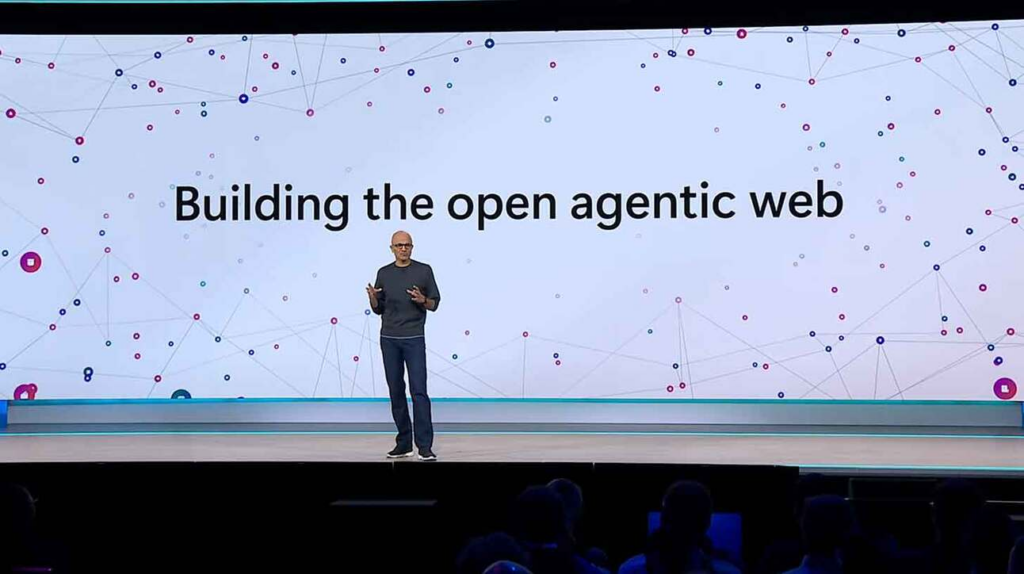
What Is the Open Agentic Web?
The Open Agentic Web is Microsoft’s vision of an internet powered by AI agents—autonomous systems that can reason, plan, act, and collaborate on behalf of users.
Instead of manually switching between tools, users will rely on AI agents that:
- Understand goals and context
- Perform multi-step tasks independently
- Communicate with other agents and services
- Continuously learn and adapt
This represents a move from apps-centric computing to agent-centric computing.
AI Agents: From Assistants to Digital Co-Workers
Microsoft is positioning AI agents as digital employees, not just chatbots. These agents can:
- Automate workflows across Microsoft 365
- Analyze data in real time
- Trigger actions in enterprise systems
- Support decision-making with reasoning and memory
By 2026, AI agents are expected to function as always-on collaborators embedded directly into daily work.
Key Developer Tools Announced at Microsoft Build
Microsoft Build emphasized one thing strongly: developers are at the center of the AI revolution.
Azure AI Studio
Azure AI Studio allows developers to:
- Build, train, and deploy AI agents at scale
- Combine large language models with enterprise data
- Manage prompts, memory, and tool orchestration
This simplifies creating production-grade AI systems rather than experimental demos.
Copilot Stack for Developers
Microsoft is expanding Copilot beyond coding suggestions into a full-stack AI development experience, including:
- Copilot for coding, testing, and debugging
- AI-assisted app design and architecture planning
- Natural-language driven development workflows
This reduces development time while increasing software quality.
Semantic Kernel and Agent Frameworks
Microsoft’s open-source Semantic Kernel enables:
- AI planning and reasoning
- Tool calling and workflow automation
- Multi-agent collaboration
These frameworks are foundational to building agent-based applications for the open web.
Why Microsoft’s AI Strategy Is Developer-First
Unlike closed AI ecosystems, Microsoft is emphasizing:
- Open standards
- Cross-platform compatibility
- Enterprise-grade security and compliance
Developers can integrate AI agents across:
- Web apps
- Cloud platforms
- Desktop and mobile environments
This openness ensures the Agentic Web doesn’t belong to one company—but becomes a shared ecosystem.
Implications for Businesses and Enterprises
Microsoft’s AI vision directly impacts how organizations will operate by 2026:
- Faster automation of complex workflows
- Reduced operational costs
- Smarter decision-making with AI reasoning
- New AI-native business models
Enterprises adopting agentic systems early will gain a significant competitive edge.
What This Means for Developers in 2026
For developers, the skillset is evolving:
- From writing static logic to orchestrating AI behavior
- From building UIs to designing agent workflows
- From debugging code to supervising AI decisions
Understanding agent frameworks, AI ethics, and orchestration will be career-defining skills.
Final Thoughts
Microsoft’s vision for 2026 is bold but clear: AI agents will become the building blocks of the digital world. With the Open Agentic Web and a powerful suite of developer tools announced at Build, Microsoft is laying the foundation for a future where humans and AI work side by side.
For developers and businesses alike, the message is simple now is the time to prepare for an agent-driven internet.