
AI Evolution: From Assistants to Autonomous Agents
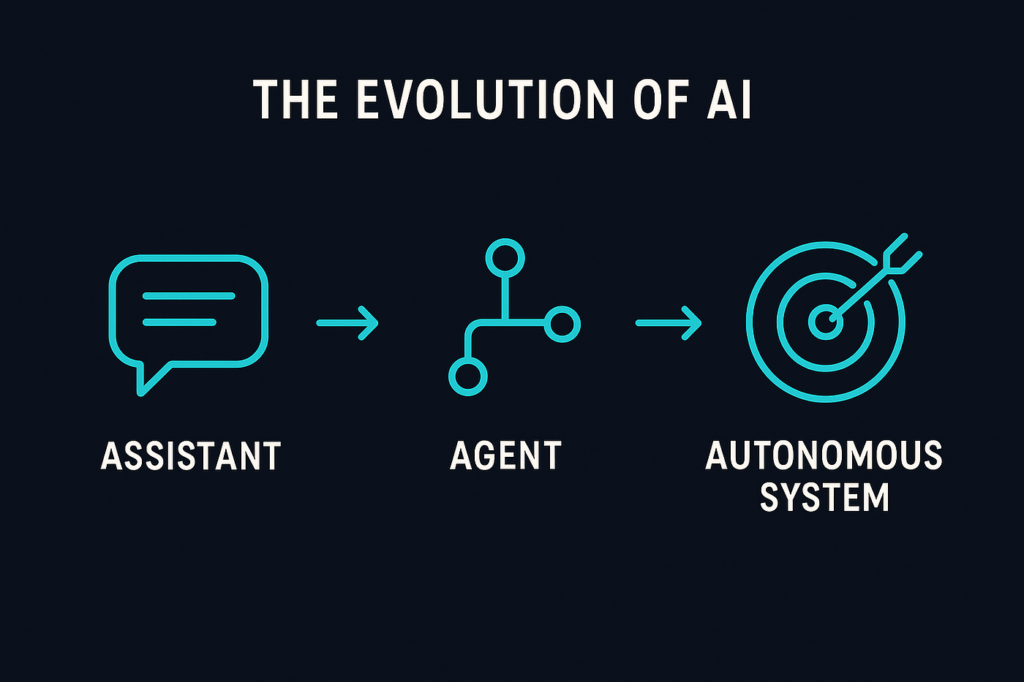
Artificial Intelligence is undergoing a major transformation. What once began as simple, rule-based assistants has now evolved into autonomous AI agents capable of reasoning, planning, and acting independently. This shift marks a turning point in how businesses, developers, and industries approach automation and decision-making.

The Era of AI Assistants
Traditional AI assistants such as chatbots, voice assistants, and recommendation systems were designed to be reactive. They responded to user commands, followed predefined workflows, and relied heavily on human input.
Key characteristics of early AI assistants:
- Respond only when prompted
- Limited decision-making ability
- Operate within strict rules or scripts
- Minimal context awareness
While useful, these systems acted more like smart tools rather than intelligent collaborators.
The Rise of Agentic AI
Agentic AI represents the next phase of AI evolution. Instead of waiting for instructions, autonomous agents can set goals, plan steps, execute tasks, and adapt based on feedback often without continuous human intervention.
What makes AI agents different:
- Reasoning: Analyze complex situations and make informed decisions
- Planning: Break goals into actionable steps
- Autonomy: Execute tasks independently
- Adaptability: Learn from outcomes and improve over time
In short, AI is moving from “assist me” to “handle it.”
How Autonomous Agents Work
Autonomous AI agents combine multiple capabilities:
- Large Language Models (LLMs) for understanding and reasoning
- Memory systems to retain context and past actions
- Tool integration (APIs, databases, software systems)
- Feedback loops for continuous improvement
This architecture allows agents to perform multi-step workflows such as scheduling meetings, managing projects, debugging code, or even running business operations.
Real-World Applications
Agentic AI is already reshaping industries:
Software Development
AI agents can write code, test it, fix bugs, and deploy applications with minimal supervision.
Business Operations
Autonomous agents manage emails, generate reports, analyze data, and optimize workflows.
Customer Support
AI agents resolve tickets end-to-end, escalate issues intelligently, and personalize responses.
Healthcare & Research
Agents assist in diagnostics, literature reviews, and clinical decision support.
Why This Shift Matters
The move to autonomous AI isn’t just a technical upgrade it’s a fundamental change in how work gets done.
Key impacts include:
- Faster execution of complex tasks
- Reduced operational costs
- Scalable automation across departments
- Humans focusing on strategy and creativity
However, this also raises concerns around ethics, accountability, security, and control, making responsible AI development more critical than ever.
The Future of Work with AI Agents
As agentic AI matures, humans will increasingly act as supervisors and decision-makers, guiding AI systems rather than micromanaging them. The most successful organizations will be those that learn how to collaborate with autonomous agents, not compete against them.
Final Thoughts
AI’s evolution from assistants to autonomous agents is one of the most significant technological shifts of this decade. It signals a future where AI doesn’t just support workflows it drives them.
Those who understand and adopt this transformation early will gain a powerful competitive edge in the AI-driven world ahead.