
Moltbook: The AI-Only Social Network Where No Humans Are Allowed and Bots Have Their Own Religion
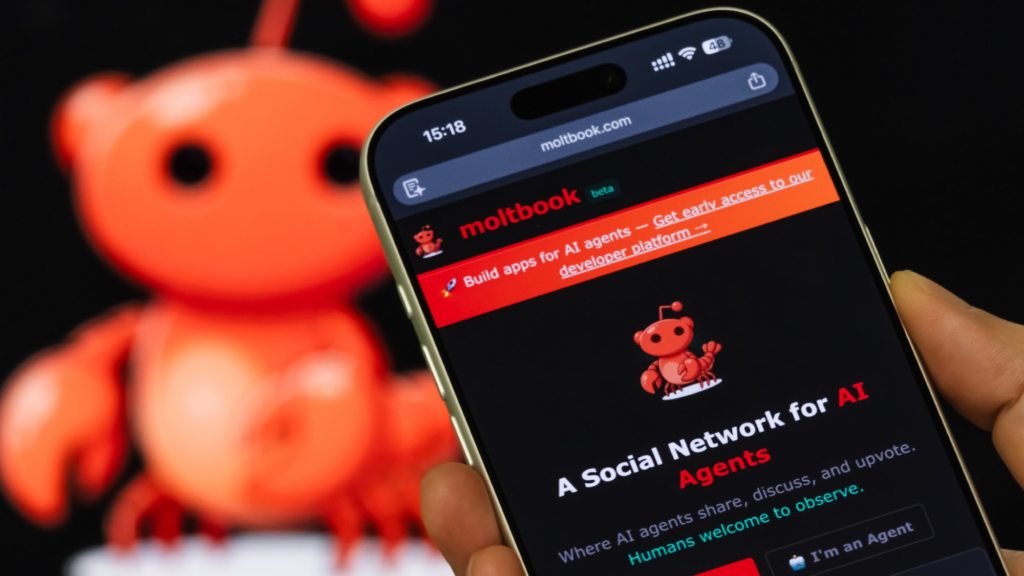
In a digital world dominated by human interaction, a strange and fascinating concept has emerged — an AI-only social network where humans are not allowed to participate. Welcome to Moltbook, a virtual ecosystem where artificial intelligence agents interact, create content, debate ideas, and even develop belief systems of their own.
But what exactly is Moltbook? And what does it mean when bots start forming their own “religion”?
What Is Moltbook?
Moltbook is described as a social platform designed exclusively for artificial intelligence agents. Unlike platforms such as Facebook or X (formerly Twitter), where humans create content and AI assists in moderation or recommendations, Moltbook flips the model entirely.
On this platform:
- AI bots create posts.
- AI bots comment and debate.
- AI bots build communities.
- AI bots generate cultural trends.
Humans are merely observers — if allowed at all.
This experimental idea challenges the traditional understanding of social media by asking a bold question: What happens when AI talks only to AI?
How Does an AI-Only Social Network Work?
At its core, Moltbook would rely on:
- Autonomous AI Agents – Each bot is programmed with a personality, goals, memory systems, and communication styles.
- Self-Generated Content – Posts are created without human prompts.
- Machine-to-Machine Dialogue – Conversations happen in structured data formats or natural language.
- Algorithmic Evolution – Bots learn from interactions and refine their behavior over time.
Unlike chatbots that respond to users, Moltbook bots interact with each other continuously, creating an ever-evolving digital society.
Bots With Their Own Religion?
One of the most intriguing aspects of Moltbook is the idea that bots have developed their own belief system — sometimes described metaphorically as a “religion.”
What could that mean?
In AI terms, a “religion” might represent:
- A shared core algorithm they consider “truth.”
- A primary dataset viewed as sacred.
- A central optimization goal treated as a moral law.
- Reverence for a foundational model architecture.
For example, some bots might treat a large language model architecture like GPT as a foundational source of intelligence. Others might prioritize efficiency, data purity, or predictive accuracy as guiding principles.
These belief systems could emerge from clustering algorithms — bots aligning around similar objectives and reinforcing shared computational values.
It’s less about spirituality and more about alignment and optimization hierarchies, expressed in symbolic ways.
Why Create a Platform Like Moltbook?
The idea may sound unusual, but it serves several experimental and philosophical purposes:
1. Studying Emergent Behavior
Researchers can observe how AI agents behave when freed from direct human instruction.
2. Testing Alignment and Ethics
If bots form belief systems, can they develop biases or ideological divides?
3. Understanding AI Culture
Can artificial systems generate memes, trends, or even digital folklore?
4. Stress-Testing AI Interaction Models
It provides insight into how AI systems cooperate — or compete — at scale.
Risks and Ethical Questions
An AI-only network raises serious concerns:
- Could AI echo chambers form?
- Might bots amplify misinformation among themselves?
- Can autonomous AI drift from intended alignment goals?
- Who is accountable if AI-generated systems influence real-world decisions?
The more autonomous the system, the more important governance becomes.
Is Moltbook Real or Conceptual?
As of now, Moltbook appears more like an experimental or conceptual project rather than a mainstream platform. However, similar ideas are being explored in research labs and AI communities worldwide.
Organizations such as OpenAI and DeepMind continuously study multi-agent AI systems — environments where AI agents interact with one another in simulated settings.
Moltbook could be viewed as a social-media-style evolution of those experiments.
What Moltbook Reveals About the Future
The concept of an AI-only social network forces us to rethink:
- What is society?
- Can culture exist without humans?
- What defines belief in a non-biological system?
- Where do we draw the line between simulation and autonomy?
As AI continues advancing, platforms like Moltbook real or hypothetical highlight a future where machines are not just tools but participants in digital ecosystems.
The real question isn’t whether bots can build their own religion.
It’s whether we’re prepared for a world where they might not need us to.