
Multi-Cloud vs Hybrid Cloud Strategy: Which One Should Your Business Choose?
As businesses accelerate digital transformation, cloud adoption is no longer optional its strategic. But one critical decision organizations face today is choosing between a Multi-Cloud and a Hybrid Cloud strategy.
While both approaches aim to improve flexibility, scalability, and resilience, they serve different business needs. Let’s break down what each strategy means, their pros and cons, and how to choose the right one.

What Is a Hybrid Cloud Strategy?
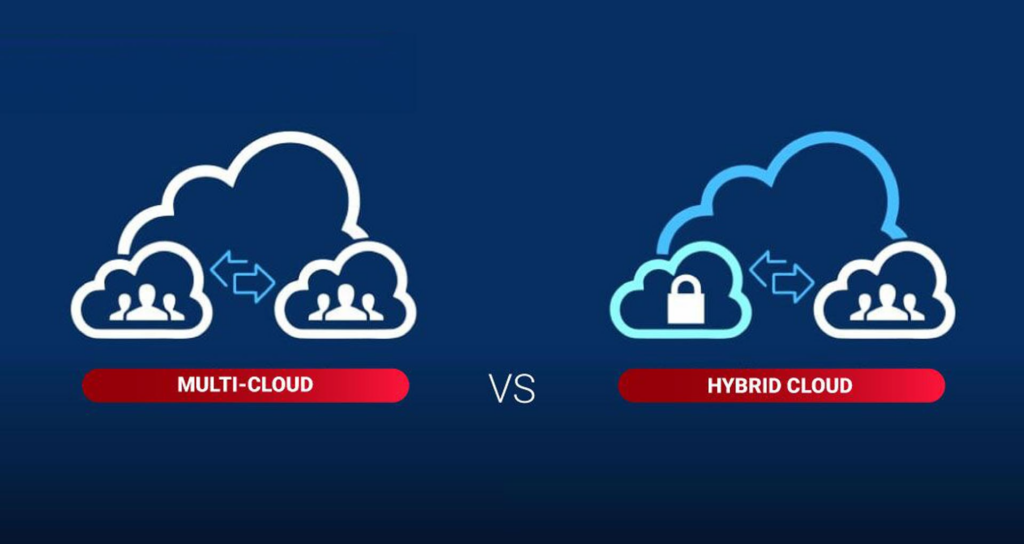
A Hybrid Cloud combines on-premises infrastructure (private cloud or data centers) with public cloud services (like AWS, Azure, or Google Cloud).
How It Works
Sensitive or legacy workloads stay on-premises, while scalable or less critical applications run in the public cloud. Data and applications can move between the two environments.
Key Benefits of Hybrid Cloud
- Better control over sensitive data
- Compliance with regulatory requirements
- Gradual cloud migration
- Cost optimization for predictable workloads
Challenges
- Complex integration and management
- Requires strong security architecture
- Higher operational overhead
Best For:
- Enterprises with strict compliance needs
- Industries like banking, healthcare, and government
- Companies modernizing legacy systems gradually
What Is a Multi-Cloud Strategy?
A Multi-Cloud strategy uses multiple public cloud providers simultaneously for example, AWS for compute, Azure for enterprise apps, and Google Cloud for analytics.
How It Works
Applications are distributed across different cloud platforms to avoid vendor dependency and leverage the best services from each provider.
Key Benefits of Multi-Cloud
- No vendor lock-in
- Higher resilience and availability
- Best-of-breed cloud services
- Improved disaster recovery
Challenges
- Increased management complexity
- Requires skilled cloud architects
- Monitoring and security across platforms
Best For:
- Cloud-native companies
- SaaS providers
- Businesses prioritizing uptime and scalability
Multi-Cloud vs Hybrid Cloud: Key Differences
| Aspect | Hybrid Cloud | Multi-Cloud |
|---|---|---|
| Infrastructure | On-prem + public cloud | Multiple public clouds |
| Main Goal | Compliance & control | Flexibility & resilience |
| Vendor Lock-in | Possible | Avoided |
| Complexity | Integration-heavy | Management-heavy |
| Ideal For | Regulated industries | Digital-first businesses |
Which Strategy Should You Choose?
Choose Hybrid Cloud if:
- You handle sensitive customer or financial data
- Compliance and data sovereignty are critical
- You want to modernize existing infrastructure gradually
Choose Multi-Cloud if:
- You want maximum flexibility
- Downtime is unacceptable
- You rely on cloud-native applications
Pro Tip: Many large enterprises today adopt a Hybrid + Multi-Cloud mix, using on-prem systems alongside multiple public cloud providers.
Final Thoughts
There is no one-size-fits-all cloud strategy.
The right choice depends on your business goals, compliance needs, technical maturity, and budget.
Whether it’s Hybrid Cloud for control or Multi-Cloud for agility, a well-planned cloud strategy can significantly boost performance, security, and innovation.